Hybrid work has stopped being a trend and started being the default. The companies that adapted well don't talk about it much anymore — it just works. The ones that didn't are still running meetings where the people in the room are the real meeting, and the people on the screen are an afterthought. The gap between those two camps almost always comes down to hybrid meeting room technology.
I say this as someone who's been working in AV for nearly a decade: the tools to fix this are mature, proven, and not particularly expensive in the scheme of things. What's still lacking in a lot of offices is the willingness to treat remote employees as first-class participants. That's a leadership decision. But once leadership commits, the AV side is actually solvable.
The cost of doing nothing is bigger than the cost of fixing it
A few numbers worth sitting with:
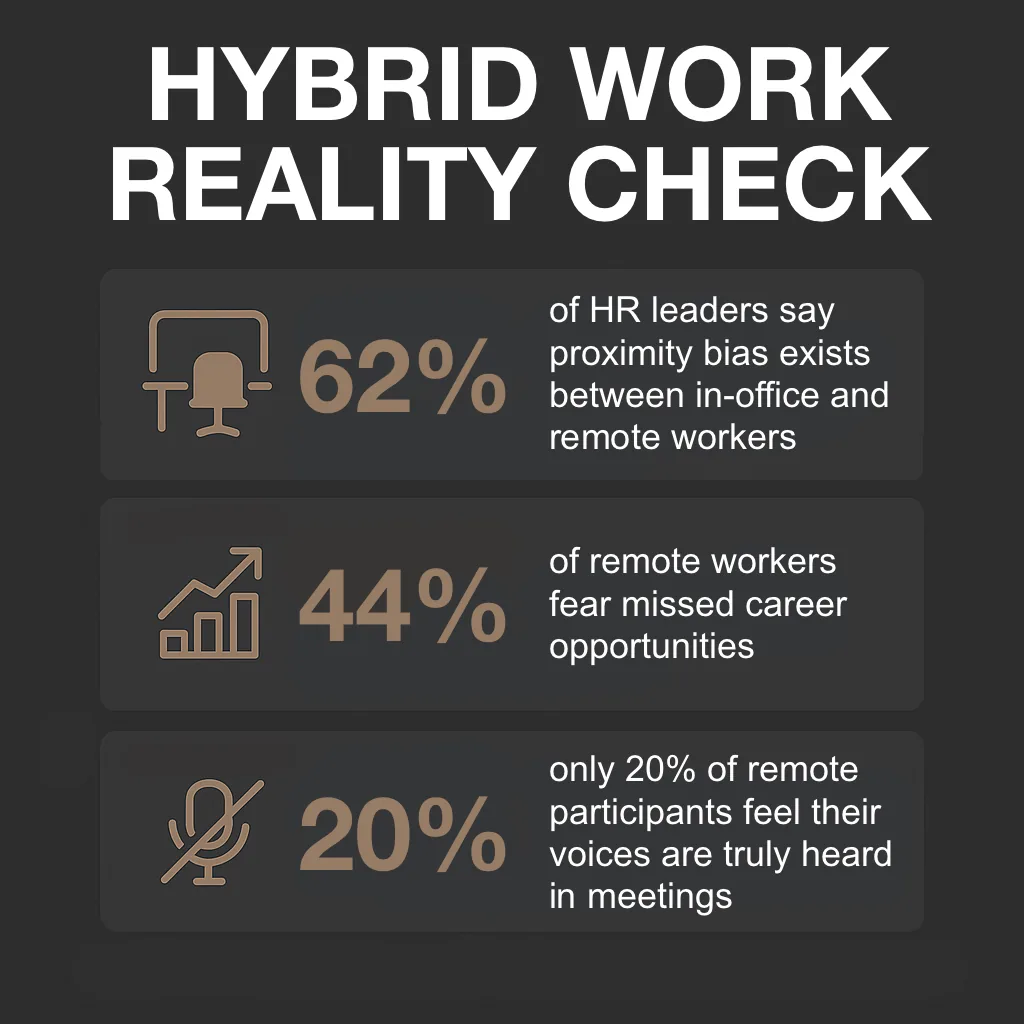
- 62% of HR leaders say proximity bias is real — in-office workers get more visibility, more credit, and more opportunities than their remote colleagues
- 44% of remote workers are actively worried about being passed over for promotions because they're not in the room
- Only 20% of remote participants feel their voice is genuinely heard in hybrid meetings
These aren't AV problems on paper. They're culture, HR, and retention problems. But they are massively amplified by how the meeting room is built. When a remote person can't hear clearly, can't be heard without shouting, and can only see the back of everyone's heads, the bias compounds itself every single meeting. Over a year, that's a career.
Proximity bias isn't just about who's in the office. It's about who the room is designed for. Most meeting rooms are still designed for the people physically in them. That has to change.
What hybrid meeting room technology actually looks like now
The good news is that the technology to solve this has matured fast. Three categories have genuinely changed what's possible in hybrid meetings:
AI-powered cameras
Modern cameras auto-frame whoever is speaking, track multiple people around a boardroom table, and can create individual tiles for each in-room participant so remote folks see them the same way they see other remote folks. No more "which blurry dot is Mike?" Done properly, a remote colleague on a Microsoft Teams Rooms or Zoom Rooms setup sees a production-quality view of the conversation, not a wide shot of a table.
Intelligent audio
Ceiling mic arrays with proper DSP behind them can pick up every voice in a room evenly, suppress HVAC noise, and adapt in real time to changes in the environment. This is where most cheap rooms fall apart, and where a well-tuned Q-SYS platform makes the biggest difference. If remote people have to ask "who's talking?" you've already lost the meeting.
BYOM and platform flexibility
Bring-your-own-meeting lets anyone walk into a room with a laptop and push to the in-room display, camera and mics — whether the meeting is on Teams, Zoom, Webex, Google Meet, or whatever's next. You shouldn't need a different room for every platform. One well-designed room should just work.
Microsoft, Berry Global, and why the big guys went all-in
This isn't theoretical. Microsoft redesigned 13,000+ of its own meeting rooms around the "Front Row" Teams Rooms layout precisely to kill proximity bias — putting remote participants at eye level, along the bottom of the main display, visible to everyone in the room. Berry Global rolled out Microsoft Teams Rooms across 200+ global sites for the same reason: to keep a distributed workforce genuinely engaged, not just nominally connected.
These companies didn't do this because AV is fun. They did it because they ran the math on talent retention and decided that the cost of a proper hybrid room was lower than the cost of losing people, or quietly hollowing out their remote workforce.
What I've seen work in real projects
The rooms that actually deliver hybrid equity have a few things in common, and none of them are about spending the most money:
- A camera solution that frames people, not furniture — and that remote participants can benefit from without anyone in the room having to touch anything
- An audio design that covers the whole room evenly, not just the seats nearest the mic
- A display layout that puts remote people at a realistic size, not a postage stamp in the corner
- A control interface so simple that nobody opens a meeting by saying "sorry, give me a sec to figure this out"
- Programming that quietly handles the edge cases — someone joining late, a mic failing, a laptop not connecting — so the meeting doesn't stop for a troubleshooting session
This is the kind of integrated thinking that good AV system design is supposed to deliver. It's not about which brand of camera you buy. It's about the whole system working together so the people in the room and the people on the screen can stop thinking about the tech and start thinking about the work.
Hybrid equity is a business outcome, not an IT project
The companies that get this right stop calling it an AV upgrade. They call it an investment in their team. Because when every voice is heard and every face is seen, the meeting actually moves faster, decisions stick, and people who happen to live outside a 20-minute commute don't quietly disappear from the org chart.
If you're building out or refreshing hybrid rooms in Vancouver or across the Lower Mainland, this is exactly the kind of work we do every day. Whether it's a single flagship boardroom or a standardised room build-out across multiple offices, independent consulting gets you a design that serves your people, not a vendor's product roadmap.
If you're tired of watching remote colleagues fade into the background during hybrid meetings, get in touch — we can audit your existing rooms, design new ones, or just give you a straight answer about what actually needs to change. No sales pitch, no buzzwords, just a conversation about making your meetings work for everyone in them.